Saturday, July 27, 2013

Check your vocabulary with: NY City's Rise to Power and Fame

First read the passage then scroll down to the vocabulary and read the passage again to improve your vocab and reading skills. Then do the fill-in-the-blank exercises.

Here's an interesting chapter from an ESL book I wrote a couple years ago. It will give you some insight into how New York City became such an important and famous city.

My book is on amazon as an e-book, and I kept the price low so that every learner of English who wants it can easily buy it. It is well worth the very affordable price: http://www.amazon.com/York-Sucks-Youll-Wanna-Anyway-ebook/dp/B004TSPAQS

The vocabulary was chosen primarily for foreign adult students of English, but many of the vocabulary words are of middle school and high school level.  Many terms are defined below the reading passage, and there is also a vocabulary exercise that will allow you to test your vocabulary.


New York City’s Rise to Power and Fame
Why did New York City become so famous?  Two reasons:  geography and money.  The geography led to the money, by the way.  Let me explain.
What’s so special about New York City geographically?  Well!  It has the deepest port/harbor in the western hemisphere.  Huge ships from Europe and all over the world could sail right up to land and unload their cargos (the goods or stuff that they carried). In regard to other cities on the east coast, sometimes the ships had to anchor out to sea and send the cargo in to land on smaller boats.  That was a real pain in the behind.  It was much better to sail right up to the land and unload or load up a ship.

Also, New York City did not really have any type of crop nearby. The soil was bad and no real crop could be grown.  A crop is a type of food that is grown: wheat, rice, barley, corn etc.  People could not survive as farmers so they became highly aggressive traders.  They built roads and canals to help farmers and manufacturers get their goods to New York City’s port, where the goods could be shipped overseas.  Once goods arrived in New York, they were easily transported out to various other regions of the country.  For example, the southern part of the USA was heavily dependent on New York City to ship its cotton overseas to England and other countries.  The South then also received various goods from England.  So the first stage of New York City’s rise was located at South Street.  This is where the main port was.  You can still go there and see some old ships.  They have lots of stores and restaurants there and few people even know that this area is what gave New York City its early boost toward wealth and fame.
People who engaged in trade out of New York City became fabulously (hugely) wealthy.  America’s first millionaire – John Jacob Astor – was one of these guys.  Astor came to America right after the Revolution, from Germany.  He began to buy animal furs from Native Americans and he would sail his ships all the way to China to trade these furs for Chinese silk, tea and porcelain. He would then sail to Europe to sell these Chinese goods.  When Astor died it was estimated that he had so much wealth that if his money were converted into contemporary dollars, he would be considered the third wealthiest person to have ever lived! (I don’t know who the first two were.)


OK, so that’s the geography part.  Guys like Astor were making so much money trading that they literally couldn’t use most of it.  Even with the fanciest houses in the USA and every luxury, they still had too much money just lying around.  So, basically, they began building banks.  This way they could loan money they didn't need to others and make a profit by collecting interest on these loans.  Where did they start building these banks?  Wall Street.  One bank after the other was built along Wall Street by the guys who made money by trading.  As I mentioned earlier, Trinity Church is the only building that still exists that existed before they began tearing down houses and churches to build banks on Wall Street.  A stock market was also set up on that street and it is now the famous Stock Exchange (get your picture taken next to the giant statue of a bull there).

So these guys who had been traders began to realize that it was a lot easier to make money by building banks and loaning out money for interest.  Within a relatively short time New York City started to become the financial capital of the world.  So do you see the development here?  New York City started out as a trading center but was so successful as a trading center, it evolved into a banking center.

It took the Civil War, however, to really launch New York City into the stratosphere.  At this time, 1861, America had two different economies – a northern industrial economy and a southern agricultural economy.  The industrial economy was based on folks who owned factories and folks who worked in factories while in the south the agricultural or farming economy was based on folks who owned land and the slaves who were forced to work on this land for free under inhumane conditions. 
The interesting thing is, traders and Wall Street bankers in New York City were making a huge amount of money from the cotton that was being produced by slaves in the south.  The cotton had to be transported up north and then it had to be shipped across the Atlantic Ocean, primarily to England.  So, believe it or not, initially folks on Wall Street wanted to support the South in the American Civil War.


In fact, southerners joked that once the south stopped sending its cotton up to New York City, grass was going to start to grow in the streets of lower Manhattan and Wall Street because there would be no business any more.  Wrong.  Once the southern states left the United States and stopped shipping cotton to New York City, the northern economy paradoxically took off.  Why?  New York City traders and bankers realized that, in reality, the southern method of doing business was not very efficient and the exporting of cotton was a good source of making money but not the best source of making money.  New York City traders soon began gathering grain and various food products from the Midwest and other northern areas and began exporting this.  At that time Europe had been experiencing a drought and desperately needed food.  So New York City lost the cotton trade but discovered a much more lucrative food trade.  The economic situation for the Wall Street bankers blossomed.
Furthermore, the United States government needed money to fight the war.  They got virtually all of the money they needed from Wall Street.  Basically, Wall Street bankers paid for the North to win the civil war.  They loaned the United States government an immense amount of money and the government paid that money back with interest.  And, now that the south was gone, the Congress was made up entirely of northern congressmen.  Southern congressmen had been stopping northern industrialization by blocking various laws that the north needed to develop technologically.  Such laws would have hurt the south.  Now that the south was gone from the Union (the term for the United States of America) the north began to pass laws that allowed the development of many new industries and technologies and the development of a transcontinental railroad system. 


Getting rid of the south for awhile and then beating the south in the Civil War was the best thing that ever happened to America!  Unfortunately hundreds of thousands of people died in this war brought about by ignorant southern racists.  Without the South the Wall Street economy really took off!  It went through the roof!  The south had been dead weight to the American economy and without the South, America was now free to fulfill its economic potential.  Or, at least, lots of bankers and factory owners got filthy filthy filthy rich.  Filthy rich means really rich. 
So this is another paradox.  Basically New York City is the most exciting city in the world primarily because of the bankers and factory owners who lived from around 1861 to 1900.  They created so much wealth in the United States of America that all kinds of things could be developed and created.  Great universities, museums, concert halls, huge department stores, skyscrapers etc.  I mean, the Metropolitan Museum, which has to be one of the greatest museums in the world, was started by these wealthy guys who made a fortune between 1861 and 1900.  Oh! Did you ever hear of The Frick Collection?   

There was a guy named Henry Frick who lived during this time and he was a steel guy – he worked with Andrew Carnegie to produce some of the best steel in the world.  Steel is the strong metal you need to build railroad tracks and skyscrapers.  He made so much money that he bought a lot of great works of art from Europeans who were desperate for money.  When he died he had so many masterworks of world art that they just turned his house into a museum!  And it’s one of the nicest museums in the city!  There are paintings by Rembrandt and Velasquez and Goya and Holbein there!  Virtually every painting is a masterwork! 

So these greedy white guys who lived for money and were super aggressive, and who often treated their workers like garbage, endowed this city with great art and great services.  That’s why I say it’s a paradox.  You would think that greedy behavior would lead to corruption and decline, but New York City seemed to develop amazing institutions.  In fact, economists have an expression for this paradox: private vice leads to public good.  So basically the more greedy people are, and the more they pursue their own economic interests, the more wealth will be generated for the public to enjoy. Yet, New York City has a huge gap between the rich and the poor, so, obviously, this system isn’t as perfect as the economists might suggest.

So there have been various incarnations of New York City.  The first incarnation was when the Native Americans lived here and farmed and hunted.  Then the Dutch came and lived pretty peacefully with the Native Americans (for awhile).  They were interested in getting beaver skins from the Indians so they could make money by making and selling fancy hats back in Holland.  So there was trade and peaceful coexistence.  If you look at the flag of New York City you’ll actually see two beavers on it.  


So we can say the second incarnation of New York City involved the Dutch, and later the English, who stole New York City from the Dutch in a war, and this incarnation was a pre-international trade New York.  Then we get the third incarnation, which was centered around South Street.  This is the big trading period where New York City’s excellent port came in handy and helped traders develop excess (more than was needed) wealth.  This period led to the fourth incarnation, which was the banking incarnation.  The excess wealth developed through trade was used to create banks which allowed more wealth to be created more easily.  These days New York City seems to remain the off-spring of these wealthy, greedy, aggressive white guys who turned to banking. Of them, J.P. Morgan was the most famous and powerful.  They turned his house into a museum as well – it’s near the Empire State Building. 

How does that make you feel?  Basically NY City kind of owes its prominence to a few guys who made zillions of dollars through trade, oil, steel and banking. I’m not sure how it makes me feel.  Should I feel grateful to these guys who were not interested in creating wealth for their society but who accidentally created it while they got filthy rich? 

Will there be another incarnation of New York?  Probably.  Who knows? I can feel New York City struggling toward something else, but without proper leadership, and New York City hasn’t had any leadership in a long time, the struggle might be in vain.

Definitions of terms

geography – the physical features of an area; i.e. Chicago is near a lake and on a flat area of land.  The city of San Francisco is located geographically in a hilly area.

a port/harbor – this is a place where ships come in to shore (land) or the place from which ships depart from the land.

right up to – some students are confused by two prepositions next to each other.  Right up to means directly up to something; practically touching something.

anchor out to – again, two prepositions…no big deal.  To anchor out to sea means that a ship drops its anchor out in the middle of the sea or far from land.  An anchor is that huge and heavy cross-shaped thing that ships drop into the water to stop the ship from moving.

in to land – again, two prepositions…moving in toward the land

a pain in the behind – If a person is a pain in your behind the person bothers you.  If something is a pain in the behind it is a nuisance or a bother.  Don't use this expression formally - it is only for very casual conversation among friends.

a boost - this is a lift off the ground; it means assistance or help, to help someone get off the ground or to help someone or something to get started.

The Revolution – this is the American Revolution, which was fought against England from 1775-1783.  Basically, this was a revolution started by wealthy people living in America at that time, but fought primarily by brave farmers and city workers.  The wealthy people did not want to pay taxes to a far-away English government that wanted to use its American colonies to support the English economy.  Basically, England wanted Americans to produce raw materials that would be processed in England and sold back to Americans.  That wasn’t fair, was it?  Of course not!  Americans wanted to process and export their own goods.  Some people have said that this “revolution” was more of a “Civil War” since the Americans had considered themselves English citizens.  That’s an interesting argument.  It’s not true, though.  By 1775 Americans and Englishmen were totally different types of people.

fur – this is the skin of an animal that helps to keep a person warm when it is worn by the person.  Many women own fur coats made of mink, for instance.

to convert – to change.

contemporary – right now.

interest – if you take out a loan, you will be charged interest.  This is extra money you have to pay back in addition to the amount you borrowed.  This allows the loaner to make a profit.  If you take out a loan you are a borrower.  Many students get confused when they use the terms “borrow” and “loan.”  If you give the money, you are loaning.  If you take the money, you are borrowing.

The Civil War – this was the war that was fought between the north part of the US and the south part from 1861 – 1865.  Basically the USA had two economies at that time.  There was a northern industrial economy and a southern agricultural (farming) economy.  The southern economy was based on slave labor.  The big issue which really caused the war to start, however, was the issue of tariffs.  A tariff is a tax on imports to a country.  The north always wanted high tariffs because they were good at producing goods and the south always wanted low or no tariffs because they liked importing stuff from England.  When Lincoln won the presidential election of 1860 the south realized he would promote an economic policy favoring the north and they left the United States and formed their own country: The Confederate States of America.  Ultimately they lost the war because of Wall Street, Lincoln, Ulysses S. Grant and many brave northern soldiers who died because they believed the world could be a more just place (a "just" place is a place with justice - real justice). God bless them for believing that.

the stratosphere – this is an upper layer of the earth’s atmosphere.  To say that something went into the stratosphere means that something really did well or really soared; it did unbelievably well.

inhumane – not showing human or humane values. If someone acts in a cruel or nasty way, he is inhumane.

a paradox – when you expect one thing and something opposite happens.

a drought – a long period of time without rain.

lucrative – if something is lucrative it generates a lot of money.

Congress – The US Congress makes the laws.  There are three parts to the US government: the Congress, The President and the Court system.  Each of these parts can control or limit the power of the other parts.  This is one reason why the USA has never had a dictator.  Even though the president is called the most powerful person in the world, his power is really quite limited by the Congress.

transcontinental – going across the continent of North America.

to take off – to soar, to rise, to increase.

through the roof – a figurative term.  If something goes through the roof it increases quickly and more than anyone could have expected.

dead weight – something unnecessary that might hold back a person’s progress.  Let’s say that you go hiking in the mountains.  You don’t want to take high-heeled shoes with you – those would be dead weight because you can’t use them.

sky scrapers – tall buildings found in cities around the world.

to endow – to fund or to provide resources to.

vice – immoral behavior, behavior which seems evil or wrong.

an incarnation – a version of something.

beaver skins – the skins from the fat little animal that likes to build dams in small streams.  You know the type of animal – he likes to float on his back.

coexistence – to live together.

to come in handy – to be useful.

the off-spring – something born from something else.

Prominence/to be prominent – if something is prominent, it stands out from other stuff.  A prominent doctor is more famous or well-known than other doctors.  

to be in vain – if something is “in vain,” that means that an effort was made but nothing was accomplished. i.e.  Jack had studied for 3 years to pass his CPA exam, but each time he took it, he failed.  All of that studying was in vain. 

15 essential vocab words  Fill-in-the-blanks

geography, a harbor, fur, to convert, contemporary, in vain, inhumane, a paradox, a drought, lucrative, to endow, an incarnation, to coexist, vice, skyscraper

Many people who object to the usage of fur coats feel that the animals used for this fur are treated in an ______________ or very cruel manner.

Tibetan Buddhists believe that the Dalai Lama is the actual, literal ___________ of the God of Mercy; the God of Mercy lives within his body.

I am an open-minded and tolerant person and I respect everyone’s religious beliefs, but I hate it when people try to _________ me to their religion by taking me to their church and trying to make me believe what they believe.

A society’s definition of what constitutes (makes up) ____________ often changes.  At one point drinking alcohol was considered immoral and wrong in America, but now alcohol is drunk freely in the States.

Henri did not want to give up the dream of owning his own business. He had worked hard and saved money for many years and he did not want all of this effort to be _____________.

Although the differing races and ethnicities in America don’t always mix with each other socially, at least they seem to ____________ with each other peacefully.

Due to scientific farming techniques, farmers do not need to fear ____________ as much as they used to.  Even if it doesn’t rain, water can be stored or transported long distances.

Some people like the artwork of the old masters but for those who like more ___________ art, the Guggenheim Museum or MoMA might be more interesting.

J.P. Morgan, an incredibly wealthy banker from the early 1900s, helped to ___________ a number of cultural institutions with his huge amount of wealth.

America not only has a diverse population but also a diverse __________; there is everything here from deserts, to mountains to prairies to marshlands.

A great transition occurred in the history of the economy of New York City when it was discovered that banking could be much more _____________ than trading; bankers made more money more easily than traders.

Although New York’s ____________ is the deepest in the western hemisphere, it is not used as often as it was when thousands of ships would sail up to the pier near South Street.

The origin of the universe seems to involve a puzzling __________: how could something come from nothing or how could something always have existed?

The Empire State Building used to be the world’s tallest ____________.  Looking at it now, it still seems tall, but that that huge.

John Jacob Astor became America’s first millionaire by obtaining animal ________ from the Indians and trading it with the Chinese for tea, silk and porcelain.


Answers are down below:


Answers: inhumane, incarnation, convert, vice, in vain, coexist, droughts, contemporary, endow, geography, lucrative, harbor, paradox, skyscraper, fur

Saturday, July 20, 2013

Vocabulary Builder: Detroit Declares Bankruptcy

Here is a vocabulary building passage based on a current news story.

To go bankrupt in the USA means that a person's debts are so high that he/she will probably never be able to pay them off.  In this case, a person (or corporation or even a city) can go to court and 'declare bankruptcy.' A judge then determines whether that person is really insolvent (incapable of paying back his/her loans).

If this is decided, the person declaring bankruptcy will only have to pay back 10% of the money he/she owes.  So if he/she owes $50,000 to creditors, he/she will only have to pay them $5,000.  However, the person's credit history will be damaged and he/she will probably not be able to get any more credit (no credit cards or loans) for at least 7 years. Also, the person will not be able to declare bankruptcy again for at least 7 years.

The city of Detroit has recently declared bankruptcy.  Basically the city used to be wealthy because of the automobile industry.  There were many jobs in this industry and the government was able to collect a lot in taxes from the companies and employees.  The US auto industry, however, has not competed well against foreign car companies, which have been making smaller and more fuel efficient models.  Therefore, due to the problems of the auto industry in Detroit, not much money has been generated, the government continually borrowed money to provide services to the people, and now Detroit must declare bankruptcy and find a way to create businesses and jobs in that city for the future.
----------------------
About the article:

During his election campaign against Mitt Romney, Barack Obama boasted of how he saved two huge automobile companies through "bailouts."  A bailout is when the US government gives money to companies to stop them from failing.  Usually the money is in the form of low interest loans.


Unfortunately for the people of Detroit, the federal government (Washington D.C.) is not going to help them.  The city where the automobile industry began is at least 20 billion dollars in debt and will have to declare bankruptcy.

Please read the article:

http://news.yahoo.com/no-signs-washington-come-detroits-rescue-170850937.html

Vocabulary to help you understand the article:

bleak - if an environment is bleak, it means there is very little there.  Antarctica has a bleak environment - it is nothing but ice and snow.  Parts of Africa have lush environments - there is a huge variety of different plants and trees and wildlife.  So if a situation is 'bleak' this means there is very little hope or few opportunities for the situation to get better.

The Great Recession - we are now still in, apparently, the Great Recession.  The world economy has slowed down to the point where there is high unemployment and not much is being produced.

bipartisan - bi means two. Partisan means political party.  So if there is a bipartisan vote, it means two political parties agree with each other and cooperate with each other instead of fighting with each other.

appetite - in this case it means 'desire.'  Neither party really wants to do anything to help Detroit.

to rescue something - to save something from harm

resources are strained - this means that at one time there were enough resources but they have been mostly used up: there are few resources left but many needs for these resources.

a constraint -  a limit.  The government is limited as to how much it can spend because the Congress did not take timely action earlier and, by law, money was automatically cut (removed) from the US budget because of Congress' inaction.

in firm control - they control that part of the Congress easily.  The US Congress is divided into two parts: The Senate and the House.  Democrats control the Senate and Republicans control the House.  Very little can be accomplished under this situation.

his plate is so full - he has so many things to do.

throwing Detroit into the mix - adding Detroit to the rest of what he ahs to do

the era - the period of time

a declining population, accelerated by hard times - this sentence might be a bit confusing. The author is saying that the decline or drop in population was due to the difficult times the auto industry in Detroit has had.

punishing - here it means very difficult.  If you go through a punishing workout at the gym, you really really workout.

in near gridlock territory - gridlock is the term for non-cooperation between the political parties.  If the parties do not cooperate, nothing gets done, and this is called gridlock.

a wait and see approach - they are not going to do anything yet...they are just waiting to see what might happen and whether they can do anything.

federal - this is the US government in Washington D.C.

to rule something out - to say something is not an option or is not possible.

insolvency - when someone (or in this case some city) just simply can't pay its debts.

diligent - careful, precise, meticulous, detailed

a tough step - a difficult move or action to take

delegation - each state gets a number of Congressmen/women based on the state's population.  This is the state's delegation.

to clamor for - to demand, to strongly request

pension funds sued - a pension is money a person gets after he retires from a job.  City workers feel that their pensions will be cut (lowered) after this bankruptcy decision, so they went to court hoping a judge would stop the bankruptcy.  The judge refused to do that.

strings attached - this means, basically, I'll give you something but I want something in return! If someone is generous they might give you something and say, "No strings attached!"

a lifeline - if someone falls into the ocean, someone might throw him/her a lifeline so that the person can be pulled to safety.

stimulus spending - when the government spends money to try to stimulate the economy (make the economy more active).

a mortgage - monthly payments people make in order to buy a house.

remote - far away; in this case, remote means unlikely.

to be off the hook - to be safe, to be able to avoid responsibility.

align them - make sure they provide Detroit with the money that Detroit really needs and requests.  To align something means to put in in line with something else - to make sure something fits something else.
------------------------------------

Thursday, July 18, 2013

Is the internet destroying academic skills?

I just wanted to share this article with you...

I'm old school - I graduated from Teachers College at Columbia in 2000.  So I remember the world before the internet.  It wasn't bad!!!!

In fact, I honestly believe that the internet can be more harmful to formal education than television ever was (and I'm not a conservative person). 

Here's something I posted on another one of my educational blogs.  It's about how using the internet may be harming the reading and writing skills of young people. 

It's based on this article: http://www.theatlanticwire.com/national/2013/07/internet-making-writing-worse/67297/
------------------------------------------------------
When I was in college and graduate school, I remember going to the library, doing research and carrying home massive amounts of books for every major paper I had to do.  Every research paper was a significant effort and I was often proud of what I had finished when I was done with the paper.

Now, students, apparently, tend to rely almost exclusively on the internet to do their research.

This article points out that, these days, because of the internet, American students are having a more difficult time reading longer passages or books and that their writing skills are diminishing (decreasing, dropping) compared to students of previous generations.

Indeed, in this article it seems that students regularly just cut and paste from a site like Wikipedia to do their papers.  What's the problem? First of all, that is plagiarism (the stealing of text from another source); second of all, if you are plagiarizing from Wikipedia, that probably means it's the second time material has been plagiarized since most of Wikipedia is badly written and plagiarized material itself. 


Finally, the 'authors' of Wikipedia articles (as was reported here:
http://convostartersenglish.blogspot.com/2013/07/further-proof-that-wikipedia-is-garbage.html ) are anonymous and potentially lacking (lacking - not having something) in any academic skills.  As you can see from the article just cited, there is a core group of 500 - 1,500 people who dominate Wikipedia (some folks have lots of time on their hands) and nobody knows whether they have adequate academic backgrounds (the article mentions two mass-murderers who loved contributing to Wikipedia).

So the following article seems to imply that students are becoming lazier and less critical about their sources.  After all, if you do a search engine search for anything, it immediately presents a Wikipedia article and most people seem too lazy to even scroll down a little bit and find a REAL article written by someone who actually has spent a significant amount of time researching the subject.

The article:

http://www.theatlanticwire.com/national/2013/07/internet-making-writing-worse/67297/

Vocabulary to help you understand the article:

teens and 'tweens - a teenager is someone between 13 and 19 - a 'tween is someone between childhood and teenage years...so a 'tween (short for 'between') might be 11 or 12 years old.

a survey - a number of teachers were contacted and asked questions and their answers were recorded and analyzed.

an atrocity - something terrible

to plagiarize - to steal text or ideas

facilitating personal expression - making it easier for teens to express themselves

collaboration - working together.

citation - properly indicating where you got your research from.

copyright infringement - stealing material from books or magazines etc.

to digest - this usually means 'to eat' but here it means to read and understand

mediocre - not good and not bad; plain,

symbolism - when a term or object represents something that is not easily spoken about.  For instance if we say that the moon is a symbol in a poem, it might symbolize some deeper concept.

silly-putty -  a type of clay that can be used by children to make things; he is saying that the brains of young Americans are being turned into clay.

that doesn't gel with - that doesn't follow or make sense compared to what they were complaining about.

but w/e - with eraser?

a temptation - a feeling that you want to do something that you know you shouldn't.
-------------------------------
Writing/discussion:

Do you feel that the internet has been a blessing or a curse in regard to education?

Wednesday, July 10, 2013

Common adjectives in "high-level" magazines/newspapers

These are 30 commonly used adjectives in some of America's best newspapers and magazines.  I went through a few magazines and culled (pulled out) these words from them. Please see whether you can complete the fill-in-the-blank exercise.  This will be challenging!

By the way, in one of the questions, I mention the book: Sophie's World.  This is a really cool book.  It's a mystery novel based on the history of philosophy.  I would highly recommend it!

In fact, here's the movie version from youtube. (The book is better.)


Answers are below the exercise.


*ailing – hurting, suffering 
*autonomous – independent, free   
*brutal – cruel, too severe, 
*conclusive – certain, absolute 
*disinterested – objective, not biased, no pre-established feelings
*effervescent – bubbly, enthusiastic, mirthful,  
*esoteric – difficult to understand, secret 
*fallacious – false 
*frantic – disordered, wild;
*grave – very solemn or serious;  
*immaculate – pure, unpolluted; 
*incessant – continual, nonstop 
*indigent - poor 
*innocuous – harmless, benign 
*itinerant – one who moves around, one who travels
*lucid  - very clear, understandable 
*mercurial- quick to change one’s emotions 
*nefarious – evil, corrupt, criminal
*obsolete – no longer up to date, old fashioned and unusable
*paltry – quite small, too small 
*petulant – quick to lose one’s temper 
*predatory – acting like a predator or hunter, 
*prosaic – opposite of poetic, mundane, common place, boring
*reactionary – opposite of radical, ultra conservative 
*resurgent – coming back
*spendthrift  - opposite of miserly, spending too easily 
*supercilious –haughty, arrogant, full-of-oneself 
*threadbare – worn out through overuse
*unprecedented – something that had never happened before
*vital – essential, absolutely necessary

1. Sophie’s World is such a good book because the author makes a difficult and sometimes esoteric subject, the history of philosophy, very _____________ and easy to understand.

2. Although the Warren Commission stated that the evidence was _____________ that Lee Harvey Oswald acted alone in the Kennedy assassination, to this day many feel that much evidence was overlooked and that the findings of the commission were faulty.

3. Contestants for the Miss Universe pageant are expected to act in an _____________ manner, regardless of how terrible the state of their nation or the world might be.

4. After the fall of communism, many states that had been included in the Soviet Union became ____________ nations with their own executives and legislatures.

5. Most ESL teachers in New York City language schools are paid a ________ sum of money, sometimes as low as $13.33/hr.  This is why they are often lazy and disinterested.

6. In Knut Hamson’s novel Hunger, the main character is so indigent that he has been unable to replace his winter coat for many months and it is ____________ and falling apart.

7. The economic crisis that began to truly be felt in 2008 was not an ____________ event.  There have been numerous economic crises and depressions in the history of the USA.

8. Although some passengers did act in a ____________ manner after the plane landed in the Hudson River, most remained calm and exited as instructed by the crew.

9. Even though some people think that the life of a journalist is bound to be romantic and exciting, I have found it to be quite ___________ and even boring.

10. Bobby Knight, a basketball coach, was felt to be a bit too ___________ by Indiana University, which fired him after a series of violent outbursts at basketball games.

11. Of all the ____________ politicians in the corrupt history of Chicago, perhaps Rod Blagojevich will go down in history as being the most disgusting and corrupt for trying to sell a political office.

12. The airline industry was already ___________ due to increased gas prices when it was hit by the economic crisis, which made the industry suffer even more.

13. Although the economic stimulus plan is meant to improve the economy, I wonder whether it will help the truly ____________ - those people who are so poor that they have little hope for a better life.

14. It seemed ironic: even though greed and the desire for “more more more” had caused the economic crisis, the government seemed to encourage people to become more ______________ and to continue buying more and more goods.

15. The world refuses to forget how ____________ and oppressive the Chinese government’s reaction was to the student protests at Tienamen Square. Tanks literally drove into the square and students were shot dead for peacefully protesting.

16. Oil had once been considered a resource __________ to the prosperity of the nation, but it is slowly being replaced by alternate sources of energy and does not seem as essential any more.

17. The pain was no longer sporadic, it just would not seem to go away. Because the pain had now become ___________, Bob went to the doctor.

18. Although the security guards for the New York Public Library threw the homeless man out of the library, many patrons complained because the man was totally _____________: so what if he was homeless and was sleeping, he wasn’t hurting anyone.

19. Americans no longer seem to even look for a potential president with an ____________ or perfect reputation. Everyone seems to think every politician is partially corrupt – even Obama supported Rod Blagojevich in two Illinois elections

20. After the extreme liberalism of the previous two administrations, the conservative policies of the new president almost seemed ________________.

21. Many people bought the novel The DaVinci Code hoping to learn of various ___________ secrets, only to be disappointed by a quite prosaic and unbelievable story.

22. It would be _____________ to assert that someone else wrote Shakespeare’s plays.  there is no evidence for this assertion.  Shakespeare wrote Shakespeare’s plays.

23. We could tell that the doctor was going to reveal bad news by the _________ look on his face.

24. Bob said that one thing he liked about Asian culture was that an Asian might go to great schools and do impressive things but never would act in a ______________ manner that might offend or embarrass others. 

25. After weeks of economic stagnation and even of times when the market declined, investors were quite happy to see the market ____________ and bouncing back strongly.

26. She was the typical opera diva with a totally ____________ personality. One minute she could be the sweetest person on the planet and the next she could be petulantly screaming bloody murder over nothing at all.

27. Billy Sunday was one of the last, famous ____________ preachers, who traveled around the USA in the early 1900s, speaking out against various evils he thought he saw, especially the evils of alcoholic beverages.

28. After thirty years there were to be trials in Cambodia concerning “The Killing Fields” of Pol Pot’s regime.  Many felt, however, that it might be hard to find  ____________judges for the tribunal since so many people had heard so many horrible things about Pot’s regime.

29. Bank loans were never supposed to be ___________ in nature.  Banks were supposed to wait for people to come to them, not go searching for people they could sign up as borrowers at high interest rates.

30. Although the type-writer is considered _____________, I still have one and although I always use a word processor now, I miss the good old days of typing letters and school papers on the old fashioned machine.

Answers are below:


Answers:

1. lucid
2. conclusive
3. effervescent
4. autonomous
5. paltry
6. threadbare
7. unprecedented
8. frantic
9. prosaic
10. petulant
11. nefarious
12. ailing
13. indigent
14. spendthrift
15. brutal
16. vital
17. incessant
18. innocuous
19. immaculate
20. reactionary
21. esoteric
22. fallacious
23. grave
24. supercilious
25. resurgent
26. mercurial
27. itinerant
28. disinterested
29. predatory
30. obsolete

Tuesday, July 9, 2013

Test your high-level English vocabulary

Improving your vocabulary and becoming familiar with high level English words will help you a lot on the SHSAT test, even though there isn't a vocabulary section, per se.

These words and sentences are pretty challenging - you might struggle a bit doing this exercise, but I think exposure to these words will help you to understand more complex written material.

Answers are under the exercises:

*ambiguous – not certain, vague, unclear 
*avant garde – in the forefront, experimental, in the lead, innovative
*bygone – a time past, in the past 
*conscientious – very sincere, concerned
*despondent – feeling hopeless 
*dispassionate – not passionate, impartial, objective
*egocentric – only concerned about oneself  (opposite = altruistic)
*exemplary – excellent, the best, the example to be followed
*fastidious –concerned with details, have a demanding attitude, critical over little things
*freelance – working for oneself 
*humane – possessing the best human qualities of kindness, mercy, forgiveness
*immutable – unchanageable 
*indigenous - original inhabitants, natives to a region
*intangible – untouchable, non-physical, can’t be physically touched
*integrated – a meaningful part of something, equally mixed in with something else
*lethargic – feeling weak and lacking energy, not capable of doing work through lack of energy
*marginalized – pushed off to the side, not central
*mercenary – doing something solely for the sake of money (like a hired soldier)
*nonchalant – carefree, unconcerned, easy-going
*obsequious – subservient, submissive, willingly doing what an authority wants you to do
*parsimonious – cheap, very frugal, miserly
*pragmatic – practical, non-idealistic
*provisional – temporary, until something better comes along
*quixotic – overly idealistic, so idealistic as to be impractical (like Don Quixote)
*relentless – not giving up, continually pursuing s/t  
*robust – strong, healthy
*sedentary – characterized by sitting 
*ubiquitous – everywhere 
*virulent – especially destructive, very strong (from the word for virus)


1. Although the Impressionist painters of the early 20th century are now looked on as being somewhat conservative in their approach to painting, the first Impressionists were truly _________________ artists who defied current standards and broke with traditions.

2. It’s true that Manhattan has not preserved a lot of it’s history, but the cemetery at Trinity Church, in lower Manhattan, helps a person see a little bit of a ____________ era in that the tombs and gravestones are from the 17th through 19th centuries.

3. There are benefits and detriments to doing ___________ work.  On the one hand you have your freedom but on the other hand you don’t have as much financial security as you would have if you received a regular paycheck.

4. I would like to think that many people in the medical profession are driven by a sense of concern for their fellow men and women, but I have seen many doctors whose motives seemed entirely _____________and who seemed to live to make money.

5. The number of health clubs has increased as our jobs have become more _____________. Some people literally sit at their desks for 6 to 8 hours a day.

6. “Stopping by the Woods on a Snowy Evening”, a poem by Robert Frost, seems to have a highly ______________ meaning; but maybe great art should not provide easy and clear answers.

7. Yellow taxi cabs are _____________ in Manhattan – you can see them all over the place - yet it is still hard to find one that is unoccupied.

8. Members of the ____________ tribes of North America have been forced to determine whether they will choose to become integrated into the dominant American culture or whether they will try to retain their own culture on marginalized reservations (areas set aside by the US Government for Native Americans).

9. Recently a best-selling book claimed that deep down inside we are all, basically, ______________, but that, coincidentally, by pursuing our own needs and desires we accidentally help others and seem altruistic.

10. Scientific laws are ______________, they never change – Newton’s Law of Gravity is the same everywhere on earth.

11. It was April 14th and completed tax forms were due the next day, yet Bob seemed quite _______________ even though he had not even begun his taxes; one would think that he would have been frantic!

12. When a young person goes to college he/she is faced with a difficult choice: should one be, perhaps, quixotic in one’s studies and major in philosophy or ancient languages, or should one be more ____________ and study something that will lead to an unambiguously prosperous or secure financial future?

13. Bob was usually quite energetic, but his recent flu had made him feel quite _____________ and he just did not feel like doing much of anything anymore.

14. Although it is true that Barack Obama, a person of color, has been elected president of the United States, it is debatable that Martin Luther King Jr.’s dream has come true since it does not seem that African Americans have yet to become ______________into American society on a level of equality.

15. The most violent and authoritarian dictators tend to surround themselves with the most _______________ assistants; such “leaders” require “yes-men” more than individuals who will challenge important decisions or policies.

16. In Hugo’s Les Miserables, Jean Valjean is pursued by a _____________police investigator named Javert, who simply refuses to give up.

17. A _____________ teacher will often be so sincere and concerned about his/her work that he/she will work with students beyond the regular school hours and will do various types of volunteer work around the school.

18. In a high-profile or very emotional court case, the defendant will hope for a _____________ judge who will not be swayed by public opinion or approach the case with his/her own prejudices.

19. The American goal in Iraq was to depose Saddam Hussein and then establish a _______________ government which would be replaced by a government elected by the Iraqi people.

20. The fashion designer had acquired a reputation as a micro-manager, but she felt that she needed to be _________________ if her clothing was going to be scrutinized closely by the press and public.

21. Although the Civil Rights Movement in America made remarkable achievements, it is still a sad fact that racial minorities are still _______________ in American society; they do not seem to receive equal amounts of funding or fair treatment in general.

22. Although Bob had lost his job due to the financial crisis, he had not become _____________: indeed, he was quite hopeful that a new opportunity would come along soon.

23. Were the ideals of the French revolution – liberty, equality, fraternity – too __________ to be established in human society, or were the leaders of the revolution not humane enough to establish these ideals?

24. Racism in the American south was so ____________ in the early 20th century that black people lived in fear of continual violence and had no hope for equality.

25. Although the Japanese economy went through a difficult period of time and became relatively weak in the 90s, the economy became more ____________ as the new century loomed and production rates increased.

26. Bob was highly praised by his boss for having done an _____________ job on the recent presentation; his boss wished everyone would do as well as Bob did on that presentation.

27. The winner of the Nobel Peace Prize is supposed to be someone who exhibits the most ______________ qualities in regard to addressing difficult world problems . Such values should include: tolerance, mercy, forgiveness, compassion, empathy etc.

28. It’s true that the world has been changed by science and its emphasis on the measurable and concrete; but most people in the world still value the more _____________ pursuits involved in spiritual activities.

29. It’s good to be frugal but Bob had become quite ________________: he only shopped at dollar stores and counted every penny that he earned and spent.


Answers are below:


Answers

1. avante garde
2. bygone
3. freelance
4. mercenary
5. sedentary
6. ambiguous
7. ubiquitous
8. indigenous
9. egocentric
10. immutable
11. nonchalant
12. pragmatic
13. lethargic
14. integrated
15. obsequious
16. relentless
17. conscientious
18, dispassionate
19. provisional
20. fastidious
21. marginalized
22. despondent
23. quixotic
24. virulent
25. robust
26. exemplary
27. humane
28. intangible
29. parsimonious

Test your vocabulary :)

There is no vocabulary section on the SHSAT, but a good vocabulary will help you do better on the reading section.  These are kind of high-level vocab words... 20 words...10 sentences....please try to find the right answers. :)

*to abduct -  to kidnap, to illegally capture and hold against one’s will
*to absolve – to formally wipe away the guilt of another
*to bellow – to yell out, often in emotional or physical pain, in a deep voice
*to chronicle – to document, to preserve for history
*to debunk – to disprove  
*to ebb – to decrease in intensity 
*to facilitate – to make more easy 
*to grapple with – to struggle with
*to hone – to perfect, to make better, to sharpen
*to incense – to make angry 
*to laud – to praise 
*to mollify – to soften s/o's anger or other emotional response
*to nurture – to care for, to raise from infancy
*to perjure oneself – to lie in court
*to ratify – to formally agree to, to approve before establishing
*to saturate – to fill or soak completely
*to taint – to poison or corrupt
*to unveil – to reveal something  
*to vacillate – to change, to not remain certain
*to yearn for – to desire intensely


If a student wishes to really ___________ a foreign language skill, he/she should probably go to a host country and immerse him/herself in the language.

Although the CIA engaged in brutal and inhumane forms of torture against suspected terrorists, the Obama administration has chosen to ___________ these officers of guilt and to not pursue criminal trials.

In times of economic or social crisis many people seem to miss and____________ more simple days when life was easier and there was less stress.

In Nanjing, during the Japanese occupation, many foreigners began to feel helpless to stop the Japanese massacre of innocent people; all they could do was ____________ what happened in the hopes that justice would be done at a later date.

Once a person in a position of authority makes a decision, he/she sometimes feels it is not a good idea to _______________; the public can interpret that as a sign of weakness.

The smart phone market world-wide has become _______________: virtually everyone has a cell phone and it’s really tough to sell more of them.

After Somali pirates _____________ members of a ship’s crew, they usually take them to dry land and hold them as hostage.

Perhaps the most difficult yet interesting topic a psychological researcher can _________________ involves our moral judgments: what is morality, how did it evolve and what control do we have over our moral actions?

No matter how many times scientists have ___________ ESP (Extra Sensory Perception), many people still believe that mind-reading is possible and there is one guy who even claims that he can bend spoons with the power of his thoughts (Yuri Geller)!

The government of China has stated that it will soon ___________ a new type of totally electric car that nobody outside of the Chinese auto industry has yet to see.


answers:

1. hone
2. absolve
3. yearn for
4. chronicle
5. vacillate
6. saturated
7. abduct
8. grapple with
9. debunked
10. unveil

Monday, July 8, 2013

Vocabulary Development: Einstein's Brain

This is the SHSAT scrambled paragraph blog I created: http://scrambledparas.blogspot.com/ Please feel free to visit it.

There is no vocabulary section on the SHSAT, but the better your vocabulary is, the better you'll do on the reading section.

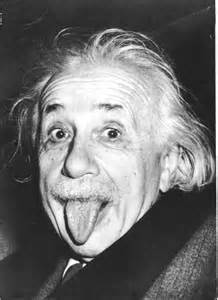
Here's an article about Einstein's brain which asks the question:  Was Einstein born a genius, or did he become a genius because of how his parents raised him and other factors in his environment?  One researcher says Einstein's genius was the result of both factors - a brain with a complex anatomy and a super-enriched environment created by parents who valued education and creativity.


The article:

http://news.sciencemag.org/sciencenow/2012/11/why-einstein-was-a-genius.html

Vocabulary to help you understand the article:

a genius - the opposite term is a moron.  You sometimes hear this term used by insensitive and irresponsible people as an insult: "You moron!" A genius is someone with a very high IQ (Intelligence Quotient).  Apparently if you take 100 people randomly and give them a valid IQ test, about 16 will score high enough (on average) to be geniuses.

a stunning insight - insight means a special, deeper knowledge.  Stunning means amazing, spectacular.  You usually have an insight 'into' something.  He has a great insight into his own emotions, motives and thoughts.  or: She has a great insight into what makes great art.

preserved - saved in a special liquid.

convolutions - like little tunnels turning in different directions

a saga - a long story

executor - a legal representative who takes care of a person's affairs after the person dies

a pathologist - a type of doctor who focuses on diagnosing diseases

embedded in a resin-like substance - placed inside a substance that was similar to resin.  Resin is a thick type of half-liquid and half-solid material.  It is a light brown color.

a peer-reviewed publication - a journal or magazine in which other researchers in a field look over and approve articles before they are published.

scattered - spread all over the place

density of neurons - a greater thickness of brain cells

gross anatomy - larger or overall anatomy

to facilitate - to make something easier

perseverance - to keep going, not stopping when faced with an obstacle

expanded - larger

a metaphor - a symbol, a creative or visual way to think of something which can't be seen

subjective - the opposite of objective, if you are subjective you are basing your ideas or opinions on how you feel and not the 'facts.'

abstract - not concrete, not 'real' or substantial.  If you are good at abstract thinking, you are good at coming up with new ideas or concepts.

predisposed him to be - if you are predisposed to do or be something, you are already likely to do it or ready to do it.  If you are hungry, you are predisposed to eat.  If your brain is more complex, you are predisposed to think about complex subjects.

nature or nurture - Is a person's personality due to nature or nurture?  Nature means biology, chemistry and genetics - to nurture a child means to raise a child.  So 'nurture' in this case means the environment.  Are we born the way we become or are we products of our environment?
-----------------------------------------